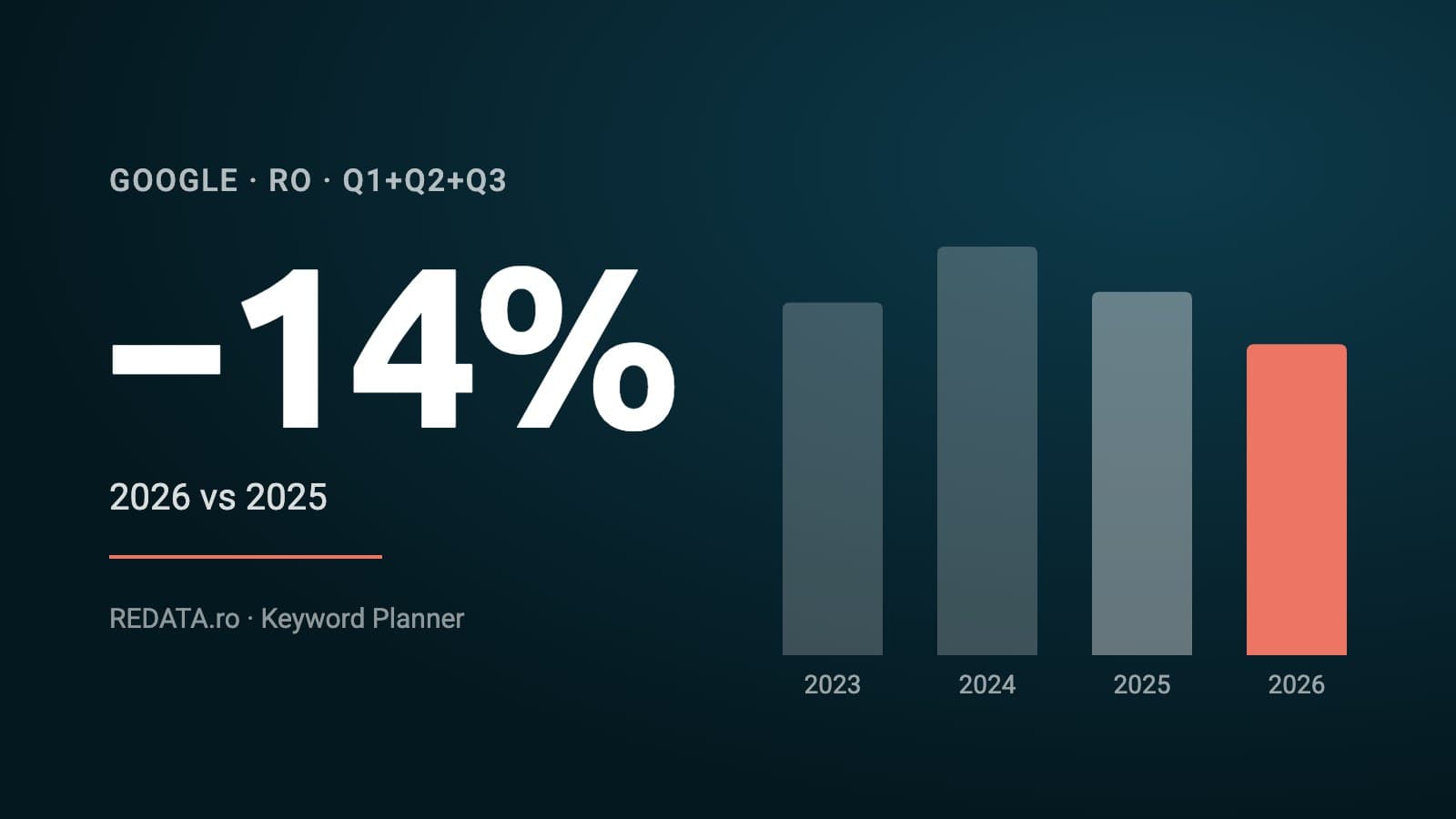
Google searches for homes fell 14% in the first nine months of 2026, and since 2024 their peak has been in January, not September. When generic demand falls, it matters more that people search for your project by name and that your website takes them quickly to prices, availability and a viewing. Below are the figures that matter for marketing and what to change in your budget, brand, measurement and website.
In short
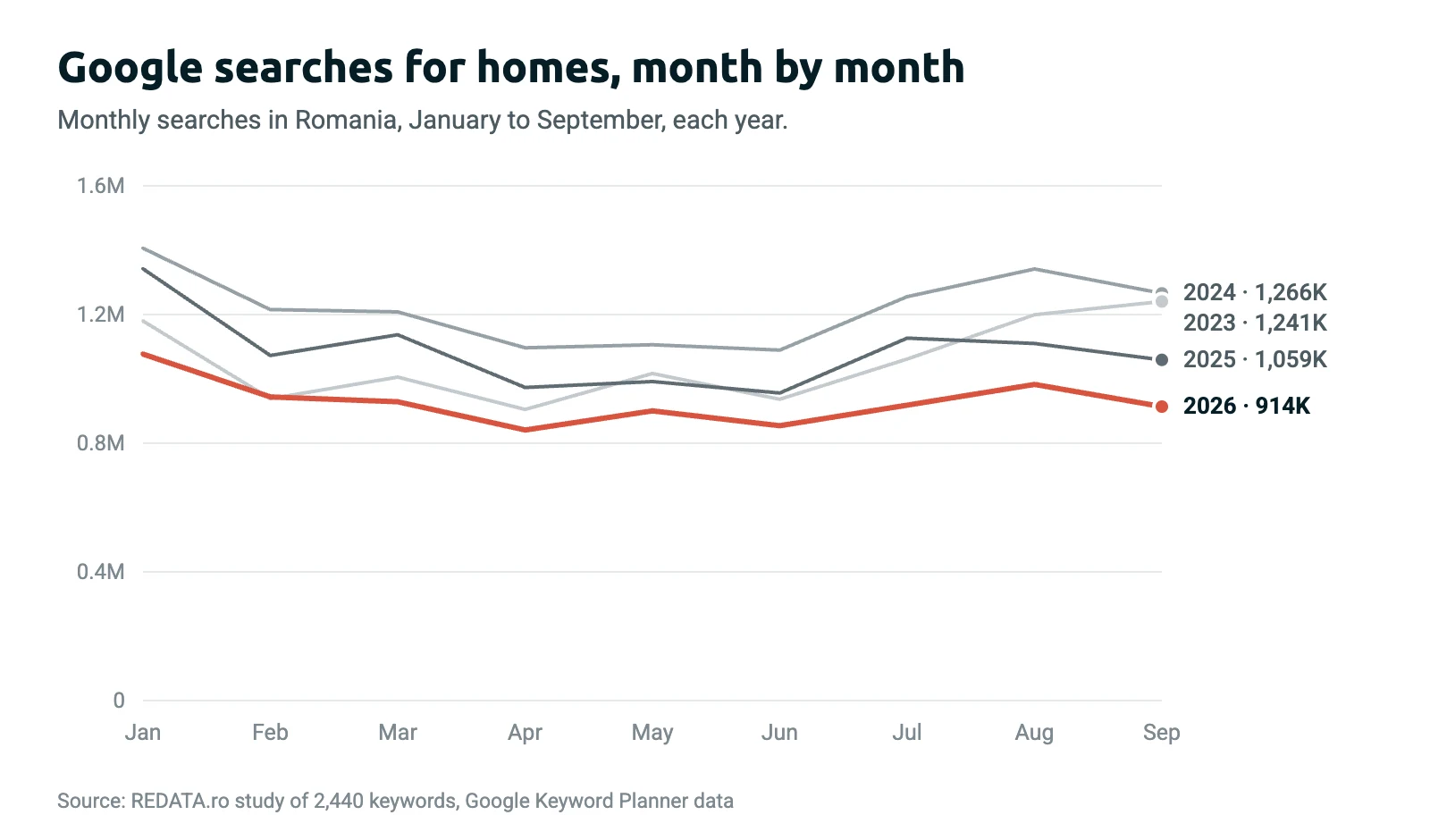
Move more of the budget into the first quarter. Since 2024, January has been the month with the most home searches, and September has become an ordinary month.
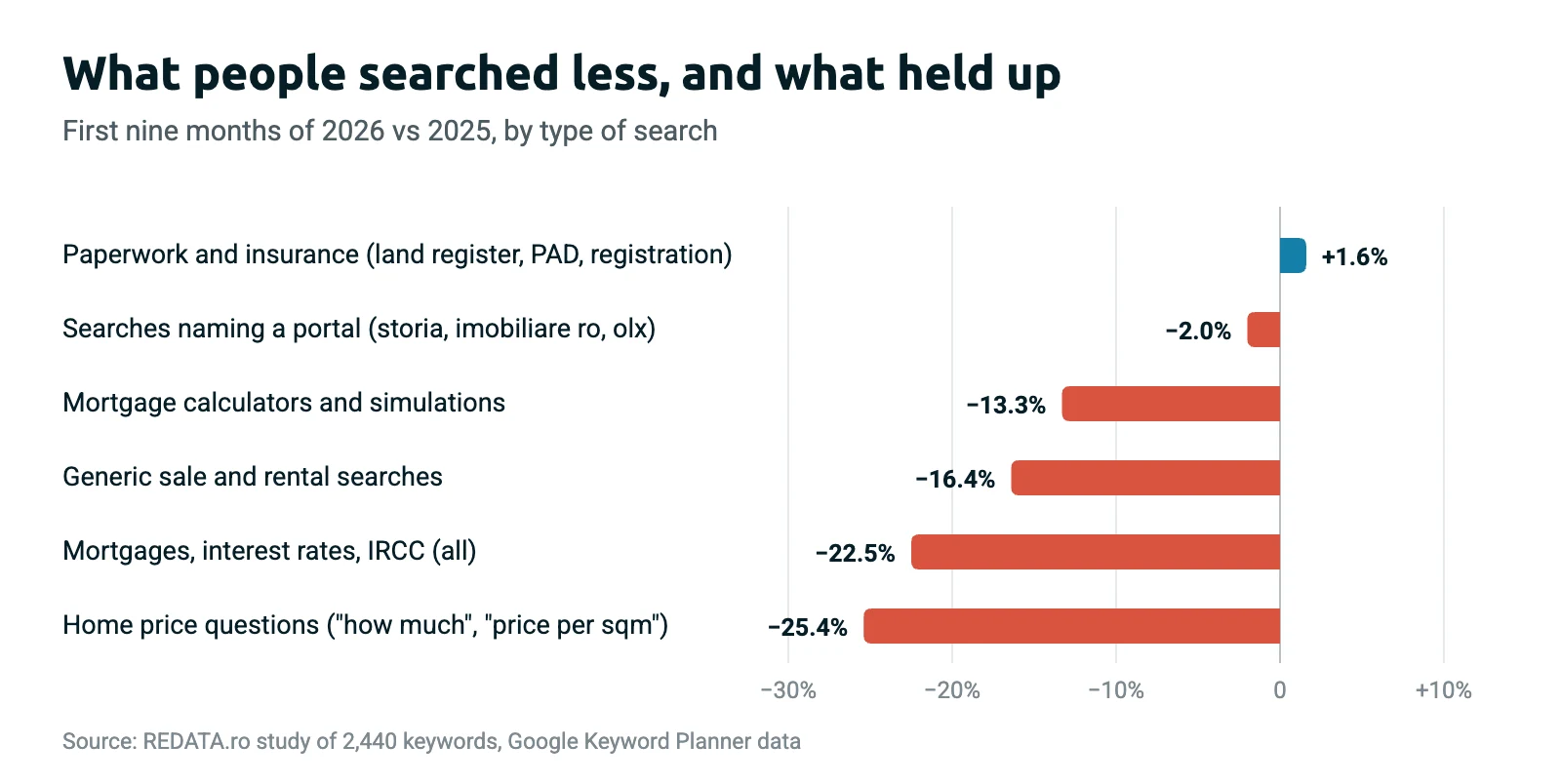
Build demand for the project's name. The study measured this for portals: searches containing a portal's name fell only 2%, generic sale and rental searches 16.4%.
Build the project's pages for buying searches: apartment type, area, prices and viewing booking. Informational searches about mortgages, paperwork and taxes are only 5.7% of the total.
1. What does the REDATA study show about searches in 2026?
That in the first nine months of 2026, the 2,440 home-related keywords REDATA tracks drew 8.4 million Google searches, 14% fewer than in the same months of 2025 and 23.9% fewer than in 2024. All 43 tracked cities lost searches.
The full study, with every city, every type of home and the methodology, is published on REDATA.ro. For marketing, three results matter most, plus one piece of context from ANCPI:
The monthly peak in searches moved to January from 2024 onwards.
Searches naming a portal held almost level (−2%), while generic ones fell 16.4%.
2-room and 3-room apartments lost the most (−24.4% and −23.1%), houses and villas the least (−9.4%).
Sales fell less than searches: ANCPI recorded 272,657 properties sold in the first half of 2026, 5.6% fewer than a year earlier.
2. When is it worth spending more?
In the first quarter. Since 2024, January has been the month with the most home searches, between 15% and 24% above the average of the first nine months.
In 2023, the peak was in September, 17.7% above average. In 2026, September was 1.6% below average, so a budget waiting for the "autumn rebound" spends the most in an ordinary month.
Prepare campaigns and materials in December, so they are live from the first days of January.
If you have a new phase to launch, don't push it to September just because "autumn is when things sell".
Run a baseline campaign all year and add budget only in the peak months.
KEY TAKEAWAY: The demand calendar changed in two years. The peak is now in January, and a budget planned on the 2023 pattern puts its money into an average month.
3. How do you grow demand for the project's name?
With campaigns that make people search for the project by name. In 2026, searches containing a portal's name held up far better than generic ones: their share rose from 10.4% in 2023 to 16%, and within that group only the most-searched portal grew ("storia", +7.8%), while imobiliare.ro lost 4.7% and OLX 8.2%.
The study doesn't measure searches for project names, so what follows is a recommendation, not a finding. Demand for your project's name is the only part of demand you build yourself; the rest you share with the whole market.
Choose a project name that is easy to type and search, and that can't be confused with other developments in the city.
Judge awareness campaigns (Meta Ads, YouTube, programmatic, outdoor) by how much they lift searches for the project's name, not just by impressions.
Run a Google Ads campaign on the project's name, so the first result when people search your name is yours.
Keep complete listings on the most-searched portal: floor plans, prices, real photos.
4. What do you measure when fewer leads come in?
Cost per viewing and per sale, not cost per lead. Searches fell faster than sales: in the first half of 2026, the tracked searches fell 14.3%, while properties sold, as recorded by ANCPI, fell 5.6%.
That suggests casual browsers leave first, and the people still searching are closer to buying. At the same time, Bucharest and Ilfov completed 6,946 homes in the second quarter, more than twice as many as a year earlier (3,201), and there almost two thirds of the homes completed in 2025 were built by companies, not by their owners, according to INS. More new apartments are looking for buyers in a market with fewer searches.
Connect forms and calls to your CRM, with the campaign source on every lead.
Report scheduled and completed viewings weekly, by channel.
Compare each channel's cost per viewing before you cut budgets.
KEY TAKEAWAY: When searches fall faster than sales, fewer people stay in the market, but probably more committed ones. A more expensive lead that reaches a viewing is worth more than a cheap one that doesn't answer the phone.
5. Which pages bring viewings when searches fall?
Pages built for buying searches, not informational ones. In the first nine months of 2026, 78.2% of the tracked searches were of the "apartment for sale or rent + city, area or number of rooms" kind, 16% contained a portal's name and only 5.7% were informational (mortgages, paperwork, taxes).
A mortgage calculator or a property-tax guide answers a small part of demand. Leads come from the page reached by someone who searched "2-room apartment" in your area: if they don't find prices, availability and an easy way to book a viewing there, they go back to the portal.
Build one page for each apartment type and area, in the words people search with: "2-room apartment + neighbourhood", not "Type B".
Show prices, at least "from", and up-to-date availability for every apartment type.
Put viewing booking right on the page, with phone and WhatsApp in plain sight, and reply the same day.
Reactivate the leads from the last two years in your CRM. When fewer new people come in, those who already asked for an offer are the cheapest demand.
Use spikes of interest (the 2026 property tax, mandatory insurance) for posts and the newsletter, not as a lead engine.
KEY TAKEAWAY: Almost eight in ten home searches are searches to buy or rent. The page that answers them with prices, availability and a viewing one click away brings leads; informational content is useful, but it answers a small part of demand.
6. How do you prepare for AI search?
You write pages as answers and measure clicks, not just search volume. The 2026 data doesn't yet show searches moving from Google to ChatGPT, Claude or Perplexity: the decline started at the end of 2024 and didn't steepen after 8 October 2025, when Google launched AI Mode in Romanian.
AI use is growing, though, from a low base. Eurostat shows that in 2025 only 17.8% of Romanians aged 16 to 74 used generative AI, the lowest share in the EU, where the average is 32.7%. The effect you can already see is different: a 2025 Pew Research Center study in the US found that users click a traditional result in 8% of visits when Google shows an AI summary, against 15% without one.
Watch the "AI Assistant" channel in Google Analytics and the click-through rate of the project's pages in Search Console.
Put concrete figures and the city and neighbourhood names on your pages. AI assistants are more likely to cite a page that answers the question exactly.
Check from time to time what ChatGPT and Gemini answer when someone asks about new developments in your area.
KEY TAKEAWAY: The first effect of AI on search is fewer clicks, not fewer searches. A page that answers the question directly is more likely to be cited than a generic presentation page.
7. How do you split the budget between cities?
By how each city moves against its own past, not against other cities. Among the 12 cities with the most tracked searches, Cluj-Napoca lost the least (−8.1%) and held almost level from April, mostly thanks to rental searches, while Craiova (−22.3%), Oradea (−20.5%) and Pitești (−20.3%) lost more than a fifth.
Where sale searches stayed close to last year's level, you can scale up lead generation campaigns.
Where they fall sharply, focus on awareness of the project and on remarketing to people who have already visited the website.
Check the search trend in your city every month, before each budget review.
Frequently asked questions
How should you adjust your real estate marketing budget for 2027?
Move more of the budget into the first quarter, invest in awareness of the project's name, and measure cost per viewing and per sale. With fewer searches, each viewing matters more than the number of leads.
When is the best time to launch a real estate project?
From a search point of view, at the start of the year: since 2024, January has been the month with the most home searches. The exact timing also depends on the project's stage and permits.
Does ChatGPT matter for real estate marketing?
Not much yet in search volume. The 2026 data doesn't show a move to AI assistants, but their use is growing, and websites written as answers are more likely to be cited.
Conclusions
If your budget still follows the autumn peak, move part of it into the first quarter.
If your project lives on generic searches like "apartment for sale + city", invest in awareness of the name now.
If the project's pages don't show prices and availability for the search the person made, you send them back to the portal.